


Generous families make life better all around. Giving does good, and giving feels good.
Here’s a simple recipe to make philanthropy a habit in your family.
Generous families make life better all around. Giving does good, and giving feels good.
Here’s a simple recipe to make philanthropy a habit in your family.
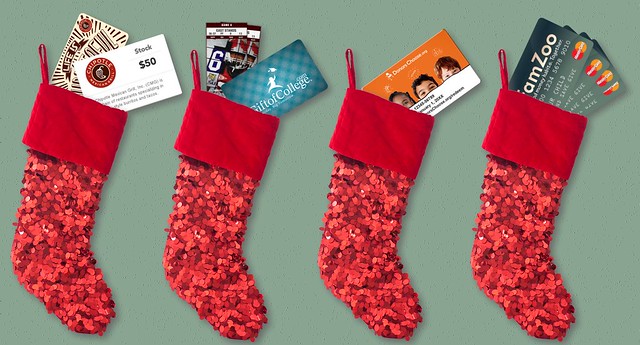

“Hey kid, here’s 20 bucks.”
“No thank you,” said no kid ever.
That’s right. No kid is going to hate you for handing over cold hard cash as a present this holiday season. The same holds for gift cards, as long as you get the brand right. That might be a little trickier than you think, judging by the billions of dollars worth of unused gift cards floating around out there.
And while cash and gift cards aren’t the most imaginative gifts, at least some folks get pretty darn creative on the packaging. Maybe you can even try your hand on some clever money origami this year.
Still, wouldn’t you feel a bit more thoughtful giving a financial gift that isn’t purely focused on immediate consumption? Perhaps something a bit longer term and, dare I say, educational?
I know what you’re thinking. Yawn. But bear with me, I’ve got some cool options that are worth your consideration.

I have a shortlist of healthy habits I’d like to instill in my kids, and charitable giving is definitely on it. It’s right up there with a solid work ethic and regular exercise. In fact, charitable giving has a lot in common with exercise:
You might even argue that charitable giving is better than exercise because it makes other people feel good too.
So how can you motivate your child to get started with charitable giving and, ideally, turn it into a life-long habit? Here are six approaches that have worked well with our kids so far.
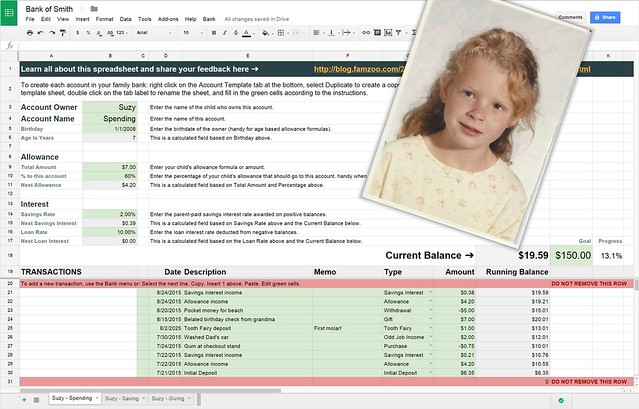

Let’s face it. Your kid’s piggy bank isn’t cutting it any more.
Sure, it was a fine first introduction to the most rudimentary concepts of money, but your kid is a smart cookie. Basic lessons learned.
So when are you going to take your kid’s money IQ to the next level? Your youngster is perfectly capable of grasping the following and more:
That sounds like a daunting parental task, but it doesn’t have to be.
You can do it all with a simple spreadsheet. That’s how I started out with my kids, and I’m not alone. The wildly popular financial blogger Mr. Money Mustache is doing the same. He’s using his “Bank of Mr. Money Mustache” spreadsheet to teach his young son about money too.

Today is Giving Tuesday — an international day of giving that falls right on the heels of Black Friday and Cyber Monday, which are apparently our unofficial national days of mindless spending. Giving Tuesday is a refreshing counterpoint to consumerism. That makes it the perfect trigger point for a family discussion about philanthropy.
Reading this after December 2? No worries. Any day is the perfect day to start a discussion about charitable giving with your kids.
Need a conversation starter? Try these 15 great quotes on spending wisely and giving thoughtfully:


Roxanne Lochridge is a “Mama” to 3 youngins, a positive parenting evangelist, and a “family scientist.” In a recent interview, Roxanne grilled me on the following topics:
Want to know the answers? You can listen to the interview here or click on the links above to jump right to the answer in the transcript below.


How about switching it up with something new this year? Something that can really change the lives of the people you care most about. Something concrete and doable. Here’s my simple suggestion: resolve to teach your kids good money habits.
Don’t know where to start? Intimidated? Here’s a list of 10 simple habits that will put your kids on the path to financial responsibility:
For Black Friday, Cyber Monday, and, sadly, even Thanksgiving Thursday, it’s shop, shop, shop; buy, buy, buy; spend, spend, spend.
Sigh. What’s next?
Thankfully it’s #GivingTuesday — today December 3rd — a day that’s all about giving instead of spending. #GivingTuesday is a national campaign to inspire personal philanthropy as we head into the holiday season.

How can you counterbalance the onslaught of consumerism and help your kids participate in the #GivingTuesday movement? Here are a few ideas for FamZoo families:
Money probably ranks right near the top when it comes to gifts that are well received by kids. No brainer, right? So, what does a kid love better than a wad of money stuffed in a birthday or holiday card you ask? Three wads of money stuffed in a card, of course! That’s what a TripleGift is.
But, wait. It it’s not as crass as it sounds. In fact, it isn’t crass at all. A TripleGift is the thoughtful way to give a monetary gift. That’s because the other two wads of money aren’t for spending. They’re for saving and charitable giving. Each TripleGift greeting card comes with three labeled pouches for spend, save, and share funds. It’s a great way to send a thoughtful, balanced money message to a child on a special occasion: money is about much more than just spending.
So what could be even better than a TripleGift card? A TripleGift card plus FamZoo, of course. Turn that positive TripleGift money message into an ongoing personal finance education. Tuck a FamZoo gift subscription inside your TripleGift card so the recipient can immediately deposit their new funds into spend, save, and share virtual family bank accounts.

Better yet, if you can plan it with the child’s parents, give them the FamZoo gift subscription in advance so they can register their virtual family bank, order spend/save/share FamZoo cards, preload some initial funds onto each, and stuff the FamZoo cards into the TripleGift pouches for the recipient ahead of time.

Interested? To learn more, check out my guest post over on the TripleGift blog.
You can order a TripleGift card here and a FamZoo gift subscription here.
“Do not save what is left after spending, but spend what is left after saving.”
~Warren Buffett

Why not start the habit early with kids? If we do, maybe it’ll be second nature by the time they enter the workforce.
“But my kids don’t get paychecks,” you say. Hmmm. What about the money you pay them for allowance, or chores, or odd jobs? What about the money they earn from watching the cat next door or babysitting? What about those birthday checks from grandma and grandpa? Those are informal “paychecks.” Apply Warren’s principle.
