Showing posts with label philanthropy. Show all posts

on
LEAVE A COMMENT!

6 Tips for Building the Charitable Giving Muscle with Your Kids

Help your kids build that charitable giving muscle!

I have a shortlist of healthy habits I’d like to instill in my kids, and charitable giving is definitely on it. It’s right up there with a solid work ethic and regular exercise. In fact, charitable giving has a lot in common with exercise:

  • Nobody else can do it for you.
  • It can be tough to get started.
  • You always feel good about it afterwards.

You might even argue that charitable giving is better than exercise because it makes other people feel good too.

So how can you motivate your child to get started with charitable giving and, ideally, turn it into a life-long habit? Here are six approaches that have worked well with our kids so far.

Like this? Please share it!

on
LEAVE A COMMENT!

Jumpstart Your Virtual Family Bank with a TripleGift

Money probably ranks right near the top when it comes to gifts that are well received by kids. No brainer, right? So, what does a kid love better than a wad of money stuffed in a birthday or holiday card you ask? Three wads of money stuffed in a card, of course! That’s what a TripleGift is.

But, wait. It it’s not as crass as it sounds. In fact, it isn’t crass at all. A TripleGift is the thoughtful way to give a monetary gift. That’s because the other two wads of money aren’t for spending. They’re for saving and charitable giving. Each TripleGift greeting card comes with three labeled pouches for spend, save, and share funds. It’s a great way to send a thoughtful, balanced money message to a child on a special occasion: money is about much more than just spending.

So what could be even better than a TripleGift card? A TripleGift card plus FamZoo, of course. Turn that positive TripleGift money message into an ongoing personal finance education. Tuck a FamZoo gift subscription inside your TripleGift card so the recipient can immediately deposit their new funds into spend, save, and share virtual family bank accounts.

Deposit Your Child's TripleGift Amounts into FamZoo's Virtual Family Bank Accounts

Better yet, if you can plan it with the child’s parents, give them the FamZoo gift subscription in advance so they can register their virtual family bank, order spend/save/share FamZoo cards, preload some initial funds onto each, and stuff the FamZoo cards into the TripleGift pouches for the recipient ahead of time.

Put FamZoo Prepaid Cards into TripleGift Spend/Save/Share Pockets

Interested? To learn more, check out my guest post over on the TripleGift blog.

You can order a TripleGift card here and a FamZoo gift subscription here.

Like this? Please share it!

on
LEAVE A COMMENT!

What's the best allocation between spending, saving, and giving for kids?

“Do not save what is left after spending, but spend what is left after saving.”
~Warren Buffett

FamZoo Average Spend/Save/Give AllocationsSmart advice from an undeniably smart investor. The saving (and charitable giving!) should come before any thoughts of spending. How do you make that happen? Automate it. Arrange to have some money automatically set aside from your regular paycheck. Out of sight, out of mind. It’s a strategy that has worked incredibly well for me personally, and something I recommend to all.

Why not start the habit early with kids? If we do, maybe it’ll be second nature by the time they enter the workforce.

“But my kids don’t get paychecks,” you say. Hmmm. What about the money you pay them for allowance, or chores, or odd jobs? What about the money they earn from watching the cat next door or babysitting? What about those birthday checks from grandma and grandpa? Those are informal “paychecks.” Apply Warren’s principle.

Like this? Please share it!

on
LEAVE A COMMENT!

Altruistic High, Tooth Fairy Finance, Teen Prepaid Card Ideas: Family Finance Picks #71

Interesting new brain science behind charitable giving, inflationary tooth fairy payout statistics from VISA, and a Mom’s clever ideas for prepaid card usage topped the list of interesting family finance articles last week. Here’s the roundup with links for deeper reading:

Hard-Wired for Giving

by Elizabeth Svoboda on The Wall Street Journal

Charitable Giving Buzz GeneratorGet your kids “high” on..... charitable giving! Sounds a bit wrong, but check out these new science findings.

Survival of the fittest! Darwins famous findings taught us that humans are hard-wired to out-compete others for the best mates and the most resources to perpetuate their genes to future generations. So why do we bother to help others? Is it just a Darwinian extension to help ensure survival of close kin or the broader tribe?

It appears to be more than that. According to new brain studies, it looks like we’re hard-wired not just for survival, but for altruism too. The bottom line: altruistic decisions give us a “buzz”. More scientifically speaking, fMRI data shows that the decision to donate to charity lights up the nucleus accumbens area of the brain which contains neurons that release the pleasure chemical dopamine.

Finally, a “drug” we don’t have to worry about our kids getting hooked on: charitable giving.

Related FamZoo Activity: Make a charitable giving goal.
Discuss on FaceBook.

Like this? Please share it!

on
2 COMMENTS

Your Kid's Allowance Isn't Just About Spending: Family Finance Picks #66

Typically, when parents hear “allowance”, parents think “spending”.

In the worst case, allowances fuel more spending. Thoughtless parents unconditionally shower bloated sums on their entitled kids who rush out to satisfy their “wants” on the latest consumer-driven fads. Instant gratification. Profligate spending. Ugh.

In the best case, allowances constrain spending. Modest sums are saved week after week by patient kids who deliberate over their eventual purchases, weighing the pros and cons of each. Delayed gratification. Disciplined spending. Good stuff!

But there’s another word I wish allowance would more readily evoke: “giving”. Allowance can be a great tool for introducing your kids to philanthropy, and cementing a lifelong habit of charitable giving. Here’s how you can get started today:

Pick a giving goal. Sit down with your child and pick a charitable giving goal that matches her interests and means. Need some ideas?

Pick a Giving Goal
  • I’ve written about DonorsChoose before here. Your kids can help students in need by helping to fund projects posted by public school teachers across America.
  • Lots of FamZoo families recommend the microfinance non-profit Kiva. Individuals can lend as little as $25 to help create opportunity around the world.
  • Our kids recently pooled their charitable account funds and made a donation to Sandy storm victims via the Red Cross.
  • In Mark Hurst’s 2013 Gift Guide, I read about a more personal way to reach out to Sandy victims through the organization Family-to-Family.

Want more ideas? Check out pick #1 below.

Make a fund-raising plan. Help your child work out a gameplan to raise the funds for the donation. Here are a few ideas to mix ’n match: set aside a portion of allowance, tackle some odd jobs, hold a fund-raising event, or convince mom or dad to kick in some matching funds.

Make a Fundraising Plan

Track progress. Review progress each week with your child. Fine tune the plan along the way if things are getting off track.

Track Fundraising Progress

Create a memorable giving moment. When your child donates her own hard-earned money to a cause, it invariably creates a strong sense of fulfillment and pride. It’s a powerful moment. Reinforce it. See picks #2 and #3 below for two recent examples of memorable giving stories involving young philanthropists.

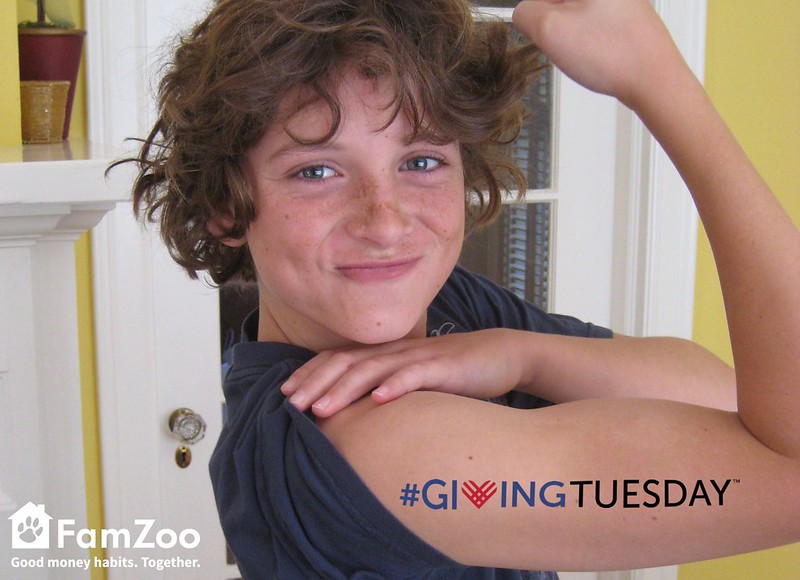
#GivingTuesday: Ideas for Families

There are lots of neat family philanthropy ideas in this article that came out as part of the #GivingTuesday campaign this year. Here’s what that campaign is all about:

#GivingTuesday™ is a campaign to create a national day of giving at the start of the annual holiday season. It celebrates and encourages charitable activities that support nonprofit organizations.

Related FamZoo Activity: Make a family charitable checklist for 2013.
Discuss on FaceBook.

Rochester Girl Spends Allowance on Statue for Vandalized Museum Garden

I love this story about a 4th grade girl’s generosity with her allowance.

Discuss on FaceBook.

Put the ‘Giving’ Back in Thanksgiving

A wonderful Thanksgiving story from Neale Godfrey showing how an allowance empowers a child to not only spend, but give.

Related FamZoo Activity: Split your child’s allowance as suggested by Neale.
Discuss on FaceBook.

When used properly, allowance can be a great tool for helping kids make a habit out of both disciplined spending and thoughtful giving.

Good luck and happy giving!

We’re constantly scouring the Internet looking for articles related to family finances and teaching kids good personal finance habits. You can visit our ever growing list of family finance bookmarks here. We’re up to 3,024 now!

Like this? Please share it!

on
LEAVE A COMMENT!

How to Encourage Your Kids to Save and Give with Matching Contributions

Automatic MatchingIn the adult world, it’s common for an employer to match a percentage of an employee’s contributions to a retirement account or a non-profit organization. Employers know that a matching policy is a powerful stimulus for driving good saving and charitable giving habits by employees.

Parents will find that the same technique works well with kids. That’s why we’ve made matching super simple for parents to administer in FamZoo by adding an automatic matching capability to our virtual family bank accounts.

Here’s how it works for a typical scenario: Suppose you’d like to encourage your daughter’s charitable giving by kicking in a 50% matching contribution for every deposit she makes to her charitable account.

Edit the Account Settings

To set up the 50% matching, locate your daughter’s charitable account on the Accounts page of the Bank tab, hover over the account with your mouse, and click on the pencil icon to edit its settings. (If you don’t already have a charitable account set up for your daughter, you can click on the Create Account action link to create one.)

Edit the Account Settings

Fill in the Matching Credit Details

Check the box to turn on automatic delivery of matching credits. Fill in a matching percentage — 50 in this case — and a description to be included as part of each matching credit transaction. We’ll use “Charitable match from Dad.”

Fill In The Matching Credit Details

The Next Time a Deposit Hits the Account...

Now any deposit into your daughter’s charitable giving account — whether it’s an automatic one from an allowance or chore, or a manual one from an odd job or gift — will be followed by a matching deposit of the specified percentage. To generate a sample matching transaction, let’s say your daughter gets paid $20 for some babysitting next door and you choose to split that between her accounts using the Split Credit form with 10% of the $20 (or $2) going to her charitable giving account.

The Next Time a Deposit Hits the Account...

A Matching Credit Will Automatically Appear

After completing the split credit, you can visit the Transactions page to confirm that the appropriate matching credit transaction has been automatically added to your daughter’s charitable account. The matching transaction description includes the match description we supplied earlier (“Charitable match from Dad”), the matching percentage (50%), and the amount being matched ($2). The Memo field identifies the original deposit that caused the match, which should appear immediately below.

A Matching Credit Will Automatically Appear

A subtle note about deleting matching transactions: if you delete the original transaction, the matching transaction will automatically be deleted as well. The converse is not true. If you delete the matching transaction, the original transaction will remain untouched. That makes it easy to selectively undo an individual matching contribution if desired.

Happy matching!

As always, if you have any questions or feedback, don’t hesitate to contact us.

Like this? Please share it!

on
2 COMMENTS

Ask Doctor G: How Do We Teach Our Children to Make the World a Better Place?

At FamZoo, we’re fond of saying that philanthropy is our (not so) “secret ulterior motive.” Are you looking for effective ways to get your youngsters into the giving habit? Whether it’s giving stuff, money, or time, our guest blogger, Deborah Gilboah, MD — aka Doctor G — has a generous supply of advice for you and your budding philanthropist.

GivingHabits


Do you ever look at your beautiful child, and think “We are so lucky. How can I teach you to really appreciate that and to help others?” Young children are generous by nature (unless it’s their toy or snack of course), and bring smiles to others with little effort. You can harness that energy and openness and teach your child through action how to find opportunities to improve the world. Older children see the flaws in our society. You can harness that clarity and motivate tweens and teens to change the world!

Even before children can articulate ideas like responsibility or compassion, you can help them discover that helping others feels good. Once kids internalize that experience, they will look for more chances to help others. As children get older, they see so many inconsistencies in the world and want to make big changes. Learning that they can effect change builds self-esteem and raises a generation of kids who will look for ways to fix problems. As you work to teach children that they can manage their own money, this builds their confidence in contributing to goodness in the world!

Giving Stuff

Give StuffOur kids often have a surplus of stuff. As they outgrow clothes, transition away from a sport or hobby, or develop beyond certain toys and games, we seek to recycle or donate those items. Involving children and teens in this process teaches great lessons.

  1. Encourage your children to go through their cast offs, deciding what is too stained or worn to give away and what could be appreciated by someone else.
  2. Bring kids to the donation site so they can understand more about the cycle of goods in our world. Also, introducing them to second-hand stores is a great financial lesson!
  3. You might consider giving them a “tax break” for donating, or at least explaining the tax breaks adults get.

Giving Money

Donate MoneyDo your children set aside some of their income (allowance or babysitting money, etc) for donation? If this is a part of your family’s ethic, here are some ways and reasons to encourage them:

  1. Offer a 1:1 match. Like a benevolent employer, can you match whatever they donate to a non-profit? If your child wants to bring canned goods for the food drive, will you buy an equal number of cans to what they purchase to double their donation? If you child raises money for the American Heart Association, will you meet their contributions? What a great way to help them do good and prove your values!
  2. Honor their passion by helping them research organizations. If you child loves animals, teach them how to look critically at the groups helping animals. How much of their donation will go to care, and how much will be funneled back into administrative costs?
  3. Involve your whole family in some of your own donation decisions. Even without telling your kids how much you donate, you can give them a voice in what percentage of your giving goes to different causes. If you are donating some to your school or house of worship, they will learn about the needs these organizations have and why you value them.

Giving Time

Give TimeThere are many opportunities to serve others in your community. Consider your child’s age and interests, and the service organizations in your neighborhood.

  • For the youngest children, the very act of playing — that thing they do best — will brighten the day of seniors at your local senior center or retirement home.
  • Does your child love to sing or dance or do karate? If your child is in a class, even a very beginner class, ask the instructor if they would do one class at the closest veterans’ hall or physical rehabilitation center. The children will do what they always do, but the group you visit will get a special experience.
  • Have an animal lover? Find an older adult in your neighborhood who might like a dog walker. Or see if an animal shelter has needs for volunteers to help clean or feed or exercise smaller pets.
  • Have you taught your child chores around the house? Look for a place he could do that same chore to help others. For example, most food kitchens require kids to be 12 to help serve meals, and they will allow families with younger kids to come in and set the tables before the clients arrive. What a great way to use table setting skills (and the plates are usually plastic!). Can your little one pick up litter? Get pairs of disposable gloves (preschoolers love these!) and go clean up their favorite playground.

There are so many ways that our kids can help others, we need only think about a time and a place we’d like to help them make a difference. Making a difference will not only build their sense of responsibility towards others, it will build their resilience and self-confidence as well!


About the Author

Deborah Gilboah, MD. - aka Doctor G.Doctor G (Deborah Gilboa, MD) is a board certified Family Physician, Parenting Speaker and mother of four boys. As founder of AskDoctorG.com, an online resource for parents and educators working to raise respectful, responsible and resilient kids, she offers live seminars to groups of parents around the country. Download Doctor G’s free tool Community Service Guide for Every Age. To learn more about her work and how it can empower you, please contact her, or find her on Twitter or Facebook!

Like this? Please share it!

on
LEAVE A COMMENT!

Philanthropy and Mentoring: What FamZoo Is Really All About

I’ve been waiting patiently for Twitter to switch our @FamZoo account over to their new user interface which includes the “Embed this Tweet” feature. Well, today was the day. Now I can post my favorite pair of tweets.

With these two little chirps, Jose Lema captures what FamZoo is all about:


BirdWe’re harnessing the latest Internet technology to lower the effort bar for parents to mentor their kids in key life skills, like personal finance. That’s what we mean by our tag line: “Preparing kids for the wild.” Along the way, we have a “secret” ulterior motive — get kids involved in philanthropy, and make it a life long habit.

Validating tweets like these make the last 6 years worth all the effort. Onward and upward!

Like this? Please share it!

on
4 COMMENTS

Reinforce Your Child's Giving Habit with Holiday Charitable Traditions

Operation Holiday CardFamily traditions are a wonderful way to turn positive behaviors — like charitable giving — into regular habits, and year-end holidays provide the perfect anchor point for establishing annual charitable traditions with your kids.

This year, we continued our simple but powerful Thanksgiving tradition of making hand-made holiday cards for the troops as originally described in this quick charitable family project post two years ago.

If you’d like to participate in Operation Holiday Card this year too, you’ll have to hurry! Your cards need to arrive to the team in Shreveport by Wednesday, November 30th.

Looking for examples or perhaps a little creative inspiration? Here are our cards from this year. The heartfelt messages give me goosebumps every time I read them.


Can’t see the embedded slideshow? Try viewing on Flickr here.

Looking for more kid-friendly charitable giving ideas? See these related posts:

Happy holidays!

Like this? Please share it!

on
LEAVE A COMMENT!

FamZoo Youngsters Support the Haiti Earthquake Relief Effort

As outlined in the FamZoo Privacy Policy, we periodically analyze "Anonymous Information records" in our database to understand our member usage patterns and to enhance the services that we provide.

An anonymous query of recent FamZoo charitable account transactions with descriptions matching the keyword "Haiti" indicates that our young FamZoo members have donated a total of $190.46 to the Haiti relief effort. The average age of the donors is 14.5 years. When you consider that the FamZoo membership currently consists of a very small population of Charter Families, this is a truly wonderful result.

It makes us enormously proud that we are achieving the "ulterior motive" behind FamZoo: to introduce and encourage the good habit of thoughtful charitable giving - a habit that we hope youngsters will carry with them into their adult years.

We must remind ourselves that individuals making seemingly small donations individually can make a huge difference when acting together.

P.S. FamZoo members, please include the keyword "Haiti" (don't worry about upper or lower case) in the transaction description of any charitable contributions related to the relief effort. That way, we'll be able to pick it up in our subsequent queries.

Like this? Please share it!

on
LEAVE A COMMENT!

Quick Family Project: Make Holiday Cards for the Troops

Last Thanksgiving, we started a family tradition that feels really good and is most certainly appreciated by the recipients: making hand-crafted holiday cards for the troops.

At the end of our Thanksgiving festivities, we gather the extended family, sit down together for an hour or so, and make cards by hand with a holiday drawing on the front and an appreciative message inside. This is one of those thoughtful, hands-on exercises that works well for family members of all ages. You can see this year's batch of cards at right.

We send the cards along to an organization like Operation Holiday Card who, in turn, routes them to our troops. Here's a wonderful picture from their site:

Look at those smiles.

There are many such organizations, so you may want to Google around and find one that works for you. Check their deadlines carefully: for example, Operation Holiday Card must receive the cards from you by Dec 2.

Some organizations send along gift boxes as well in which items are selected from a vetted list. That's what we did last year. This can be a great way for kids using FamZoo to deploy the balances they have built up in their charitable accounts. When the kids buy charitable items with their own funds, it makes the experience that much more meaningful for them.

Like this? Please share it!

on
1 COMMENT

Minimum Requirement: 5 Minutes and a Heart

The holiday season and the start of the New Year is always a great time to reinforce your charitable values with your family. If you are looking for a simple and meaningful charitable exercise for your kids that works for any age and engages them on a personal (and not just monetary) level, here is a suggestion: have your child make a card with a personal thank you message to our troops and their caregivers. The card can be delivered through Homefront Hugs and their Operation Healing Angel program.

Here is an example from one of my sons:

This simple exercise creates a great opportunity for some teachable moments with your child. It's also guaranteed to generate positive energy on both sides of the send/receive equation.

On a related note, for those of you with a FamZoo virtual family bank, now is an excellent time to review any outstanding balances in your children's FamZoo charitable accounts. If a balance has accumulated, take some time this week to sit down with your child, choose a charitable organization, and make a contribution. Some quick suggestions: DonorsChoose.org (mentioned in last year's holiday blog post), NothingButNets.net, and "charity:" (mentioned in a recent blog post by the president of Charity Navigator).

As of today, a total of $3,106.01 has been added to FamZoo charitable accounts and, of that, $186.10 has been distributed so far. This leaves an aggregate undistributed balance in FamZoo charitable accounts of: $2,919.91. That's some serious money. Help your kids put it to work this week.

Like this? Please share it!

on
LEAVE A COMMENT!

Need a Last Minute Stocking Stuffer? Try the Gift of Giving...

If you are searching for that last minute stocking stuffer, perhaps suffering from a touch of yuletide materialism fatigue, and seeking to involve your youngsters in charitable giving - here's a quick and easy idea: consider a charitable gift certificate that allows the young recipient to choose where the funds go.

In my case, I purchased gift certificates from DonorsChoose for each of my kids (click here). I suspect there are other similar sites, but this is the one I am most familiar with, and I really like it. Selecting the email delivery option, I was able to print out the certificates, place them in envelopes, and add them to my stocking stuffer stash - all in a matter of a few minutes. Here's what one looks like:

I'll be challenging each of the kids to make their charitable selections by January 1st. Seems like a nice way to close out the year and kick off 2007.

Happy holidays to all!

Cheers!

Like this? Please share it!

on
3 COMMENTS

DonorsChoose.com: A Neat, Convenient Way to Introduce Kids (and Others) to Philanthropy

In my last post, I spoke briefly about my interest in engaging children in philanthropy - the earlier the better. Of course, there are many effective ways to do this, but one that I find particularly intriguing given my interest in the Internet and online marketplaces is a site called DonorsChoose. Quoting from their homepage, the nutshell summary is: "Here, teachers submit ideas for materials or experiences that their students need to learn. Individuals like you can choose a project and make it a classroom reality." Really cool - a philanthropic online marketplace that matches teachers with donors to fulfill a wide variety of educational needs that would otherwise probably go unfunded.

I first heard about DonorsChoose last year when I spoke on a panel at a Kleiner Perkins venture capital event. In return for speaking, KP gave each of the panelists a coupon to DonorsChoose that could be used to fund (or partially fund) a project of our choosing. Since my own children are very involved in music and I have become very passionate about supporting programs in that area, I selected a project entitled "Piano Keyboard for Our Classroom". A kindergarten teacher in a predominantly low income school district of San Jose, California with no money for drama, art, gym or music instructors, was seeking donations to fund a digital keyboard to use in his classroom. You can view the original project proposal here. I used the KP coupon to fund a portion of the $420 request.

I was very impressed with how easy, smooth, and gratifying the whole process was. A few months later, I received a hand-written "thank-you" note from the teacher describing the impact in the classroom. Included in the thank-you packet was a set of photos showing various students playing on the new keyboard in the classroom - fantastic!

This struck me as a very simple and meaningful way to start engaging your children in philanthropy. A way that allows them to perform their own research, use their own funds, make their own decisions, and see a very tangible, near term impact.

Here's a thought: the next time you feel the need to give your child a project (they're bored, spending too much time in front of SpongeBob, too wrapped up in themselves, etc.), try the following (assuming you have set up your own account on www.donorschoose.com):

  • Show them the site and the basics of how to get around
  • Tell them to search for and make a list of 5-10 projects that they think are particularly meaningful to them (I prefer this to choosing just one - it overcomes the initial temptation to hastily pick any old one without getting engaged and forces a deeper critical evaluation).
  • Have them sort the list from "least deserving" to "most deserving" with an explicit comment about why each is more deserving than its predecessor in their opinion (of course, they are all likely to be "deserving" projects - the point is to get them to think more deeply about what they want to donate to and why).
  • After some discussion, fund the chosen project (or typically a portion thereof). Ideally, the funds would come from the child (perhaps built up in a "philanthropy account" over time by deducting a percentage of weekly allowance - you might consider matching contributions as well).

See how it goes - I'm trying this myself now.

I'm hoping to be able to create some linkage between my new venture and DonorsChoose or sites like it. We'll see if that pans out. If you know of similar sites, feel free to leave a comment - I'd be interested to hear about them.

Like this? Please share it!