on | LEAVE A COMMENT!

Haley's Weekly Family Finance Picks (#5)

This is entry #5 in a weekly summer series by "guest blogger" and FamZoo summer intern Haley Dwight.

My top three family finance picks for this week are:

Five Financial Concepts Your Child Should Know by Andrew Salmon for Our Kids

Learn How to Budget Early On!

Andrew encourages teaching your child five concepts about money:

  • the value of hard work,
  • wants vs. needs,
  • compound interest,
  • how credit cards work,
  • and budgeting fundamentals.

These are all important ideas for children to become familiar with before entering the adult world. On the budgeting topic, Andrew says the right time to start is “once your child is earning a regular pay check in place of a weekly allowance”. Here’s where I’d disagree a bit. There’s no reason to wait until a child is of working age to teach good budgeting habits. Why not put your child in charge of an expense like clothing earlier on? Have the child work out a budget with you, and then give them an allowance that matches that budget.

Allowance Tips to Raise Good Money Managers by Kim Grigg for Yuma Sun

Kim provides clear guidelines on which money skill to “teach” and what “tool” to use at each age level: pre-schoolers, elementary-schoolers, tweens, and teens.

Kim mentions that the time to start a savings account for your child is elementary school. Something to consider: If setting up a savings account in a real bank for your youngster sounds like a bit of a hassle for a relatively small balance, you might consider starting with a virtual savings account in FamZoo. You can teach the same lessons about the power of compounding interest (you get to set the rate and compounding period) as well as the discipline of saving a portion of your regular income (say ten to twenty percent of allowance a week). Children can easily log on to FamZoo to watch their account grow with every allowance and interest deposit! My youngest brother, Quintin, even likes to deposit extra change he finds laying around (possibly from Dad’s coin jar…), and his savings account has grown a significant amount!

Once the virtual savings balance builds up to a significant amount, you might choose to roll it over to a real savings account as suggested in the article.

A New Tool to Teach Children About Money by Jennifer Saranow Schultz for The New York Times Bucks Blog

OK, I couldn’t resist this one: FamZoo is featured in the New York Times personal finance blog!! See what my dad has to say about his growing company :)

To top off the week, we were also featured on HLN’s Morning Express with Robin Meade in a family finances segment by Jennifer Westhoven.

It was a big week for FamZoo in the media. Woohoo!

FamZoo on HLN Morning Express with Robin Meade
on | LEAVE A COMMENT!

Haley's Weekly Family Finance Pick (#4)

This is entry #4 in a weekly summer series by "guest blogger" and FamZoo summer intern Haley Dwight.

Before I start my weekly blog post, I have a bit of a confession to make. The sad truth is that I failed to complete my top 3 this week. I had another job and my Dad was out of town, which made it very hard to focus on my work here at FamZoo :(

I did, however, stumble upon an article that I want to share. So here is my “top 1”.

Children’s Allowance: What and When to Pay by Ray Martin for CBS Money Watch

Happy 4th of July!
My youngest brother when he was a baby - so cute!
Happy 4th!

Ray offers four tips to giving an allowance:

  • teach important lessons with small amounts of money,
  • start giving an allowance once your child understands that money is exchanged for goods,
  • generally do not give money in exchange for chores or grades, and
  • pay enough to cover a certain amount of agreed-upon expenses.

I love the idea of agreeing upon a budget and making your child responsible for managing expenses within it. My parents have taken this approach with our family. Us kids are responsible for paying any entertainment, dining, and clothing fees and staying within our budgets. If we want something extra, we save for it. As you may know, FamZoo just released a budgeting feature, which is perfect for planning any type of budget with your child!

on | 14 COMMENTS

What's Your Teen's Clothing Budget and Allowance?

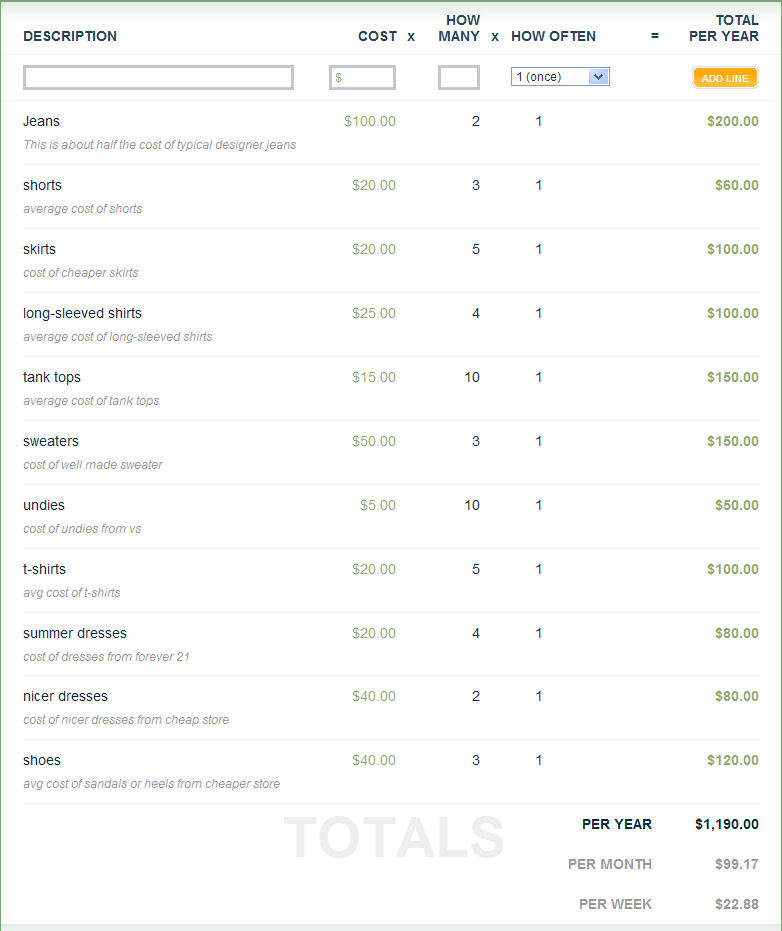
What’s your reaction to this clothing budget for an older teenage girl?

Older Teen Girl Clothing Budget Sample

Click to enlarge.

Here’s one of my favorite approaches to teaching kids how to spend wisely: put them in charge of a fixed budget for a specific area of spending. For teens, my wife and I always pick clothing first. It’s a well defined area. It’s a "need" that can quickly morph into a “want”. It’s something that most teens care about a great deal. It’s prone to lots of impulsive decision making and peer pressure. It’s often an emotional friction point between teens and their parents.

In other words, it’s a perfect opportunity for teaching your kids some fiscal discipline in a hands-on way.

Here’s our simple approach:

Have your teenager submit a formal annual clothing budget proposal

List each line item with estimates of typical price and quantity. This tends to be a real eye opener for the teen and even the parent!

Revise the budget proposal until it’s appropriate.

What’s appropriate? It depends upon your family’s financial situation, your family’s values, where you live, and numerous other factors. This phase invariably leads to meaningful parent-child dialog and greater common understanding. It’s a good idea to record some simple explanatory notes along with your final budget. The historical record can come in handy if (when) spending gets off track later.

Establish a regular allowance that matches the overall budget.

The allowance can be weekly, monthly, yearly, or whatever. We like to create an annual allowance and fund the clothing expense account all up front. This challenges our teenagers to handle a large chunk of money wisely over a long period of time. That’s a skill that takes some trial and error to master.

Track the balance and step aside.

Keep track of the running balance in the clothing account and, otherwise, leave the decision-making up to your teen. Well, for the most part. You’ll probably want to set a few basic ground rules up front about what’s off limits. Do what makes sense for your family. But, by all means, let them make the inevitable poor decision here and there. Let them experience the consequences. Make sure they clearly understand one hard and fast rule up front: when it’s gone, it’s gone.

Prom Can Take a Big Bite Out of That Clothing Budget!

Want to explore the topic more deeply? Here are two excellent resources:

How do you handle purchasing clothes with your teen?

How would you revise the sample budget at the top of this post?