Showing posts with label Budgeting. Show all posts
on | LEAVE A COMMENT!

Simplify Family Budget Sharing With Digital Wallets

FamZoo Dining Out Budget card in two digital wallets.

You have one Dining Out budget for the family, but several family members buying meals. How do you make sure everyone’s purchases come out of the same pool of funds?

Earlier this year, I described how to manage a shared family budget with FamZoo: put the budgeted funds on a dedicated card, transfer money to each family member’s spending card before a purchase, and return any excess afterward.

That approach still works. But digital wallets offer a convenient — and highly secure — shortcut.

Add the same shared budget card to each participating family member’s digital wallet. Then select that card before paying.

No transfers back and forth. Each purchase draws directly from the same shared balance.

I tested this with my own FamZoo card: I added it to Google Wallet on my Android phone and to Apple Wallet on my wife’s iPhone. Same card. Two phones ready to tap to pay. One budget.

Here’s how to put that approach to work for your family.

on | LEAVE A COMMENT!

Activity Alerts: Awareness Is the New Default

Card activity alerts

Can you name the FamZoo family money feature that is simple and effective, yet seldom used?

A few hints. It can:

  • Make spending more visible and mindful.
  • Spark important family money conversations.
  • Catch suspicious activity early.
  • Help family members stay on budget.
  • Reveal when a family member is struggling with a card — and why.

What is it?

on | LEAVE A COMMENT!

Kakeibo With FamZoo: Manage Money Mindfully

I’ve seen many family budgeting systems collapse under their own weight: too much planning required to get started, too much overhead to maintain, too sterile to make anyone really care.

The Japanese practice of Kakeibo addresses those shortcomings in a simple yet deep way.

Kakeibo is often translated as “household financial ledger” or “household account book.” It’s a Japanese household money-management practice popularized by journalist Hani Motoko in 1904 that emerged from a centuries-old tradition of household and merchant ledger-keeping.

Kakeibo is much more than a mechanical budgeting system. It’s an ongoing practice to slow money decisions down just enough to make them more intentional and more aligned with your evolving reality.

on | LEAVE A COMMENT!

How to Manage a Shared Family Budget

Family sharing a dining budget

Families have been using FamZoo cards as a simple, effective budgeting tool since 2013. Multiple cards are used to partition funds into separate subaccounts dedicated to specific purposes: everyday spending, saving for a goal, charitable giving, dining out, clothing, online gaming, family vacations, you name it.

This works beautifully when the funds in a subaccount are spent by a single family member. But how do you handle the case where multiple family members need to draw from the same budget bucket?

Over the years, families have developed a set of best practices for managing this scenario. Here’s how to apply them using a family-wide monthly budget for dining out. Note: I’ve arbitrarily chosen a monthly budgeting cycle for this Dining Out example. Choose any budgeting cycle — monthly, weekly, quarterly, annually, even daily or ad hoc — that fits the category and your family’s circumstances.

on | LEAVE A COMMENT!

Find Your Family’s “Frictionless” Spending

When you have to type your card information into a site or app — or make a payment in person with a swipe, dip, or tap — that little bit of friction creates a small “speed bump” to spending: a brief moment to reconsider whether the purchase is really worth it.

Friction is the enemy of mindless spending.

On the other hand, mindless spending thrives when all friction is removed.

So how do merchants remove spending friction?

By storing your card information as a convenient, automatic payment method.

The result?

  • Free trials turn into subscriptions you didn’t mean to start.
  • Subscription payments continue long after you’ve stopped using the service.
  • Small purchases for in-game items and downloaded media pile up.
  • E-commerce checkout becomes a little too easy.

That’s why one of the simplest ways to rein in mindless spending is to periodically identify all the places your card is stored on file with a merchant.

Fortunately, FamZoo makes this very simple.

on | LEAVE A COMMENT!

Picking The Perfect Allowance Amount

Another day, another allowance survey.

A 2025 Wells Fargo survey reports that the average weekly allowance parents pay kids is $37.

A 2025 StudyFinds survey says children receive about $119 per month on average.

A 2024 T. Rowe Price survey found the average weekly allowance across respondents was $19.39.

Hot take: allowance surveys are completely useless.

The amount of allowance Parent A pays their child is meaningless for Parent B.

Why?

on | 1 COMMENT

Boredom-Free Budgeting Practice for Kids

Mom teaching budgeting

Budgeting is a critical life skill. So, it behooves your child to learn some budgeting basics before leaving the nest. But, like any skill, budgeting takes practice to master.

Unfortunately, few things sound more boring to your kid than: “Let’s build a budget together!’

How do you beat back the yawns? A little AI, an interactive scoreboard, and a cash bonus opportunity.

Try this technique using ChatGPT, Google Sheets and FamZoo. (Of course, you can substitute your favorite AI chatbot, spreadsheet, and payment method.)

on | LEAVE A COMMENT!

How to Conduct a Year-End Financial Review With Your Child

Prime Charge Through Magnifying Glass

Now is the perfect time to sit down with your child and conduct a year-end review of their finances. If delivered diplomatically, a gentle audit will nudge them toward better fiscal habits in the year ahead.

To set the right tone for a candid exchange, I like to break the ice by confessing one or two boneheaded financial mistakes of my own. Like when I wasted a gazillion dollars on an unnecessary storage locker — for 13 years! Hey, we all make financial mistakes, right?

As you browse through your kid’s transactions from the past year together, here are a few things to look for and discuss:

on | LEAVE A COMMENT!

How To Manage A Teen Clothing Budget

Parents often ask me how to teach teens budgeting basics. My favorite approach takes a page from the envelope budgeting system playbook, but with a digital twist.

In the traditional envelope system, each category of spending has its own labeled envelope stuffed with the budgeted allocation of cash for the month. Purchases must be funded with the cash from the appropriate envelope. So, all clothing purchases come out of the envelope labeled “clothing”. Super simple.

For the digital twist, replace cash-stuffed envelopes with automatically loaded FamZoo cards. So, all clothing purchases come out of the card labeled “clothing”. Still super simple. And it works in today’s online world where cash is no longer welcome.

When introducing teens to budgeting, I recommend keeping things narrowly focused. No need to overwhelm. Start by choosing just one envelope outside of everyday spending. Clothing is typically an excellent choice for teens.

Here’s how to get your system up and running:

on | LEAVE A COMMENT!

How To Set Up The Ideal Teen Budget

Annual Teen Clothing Budget

You’re looking for just the right financial setup for your teen.

Not too simplistic: learning is the goal. You want your teen to master critical money management skills before leaving the nest.

Not too sophisticated: no need to boil the ocean here. Don’t create a monster your teen hates and you can’t manage. You’re a busy parent. Having helped raise 5 teens, I get it.

For the sweet spot, I recommend a 4 bucket system with card accounts for:

  1. Everyday expenses
  2. Saving
  3. Charitable giving
  4. Clothing expenses

(Note: if your teen could care less about clothing, pick some other budget category that they really care about: sports, music, art, gaming, whatever.)

When ordering cards, click/tap Add Card next to your teen’s entry to add each of the four cards. Fill in the custom label line with the corresponding short description above (or similar) and select the appropriate spend / save / give category for each.

When the cards arrive:

  1. Activate the cards.
  2. Set a memorable but secure PIN for each.
  3. Create a modest weekly allowancethat splits the amount between the first three accounts.

    I recommend discussing the split percentages with your teen to come up with a reasonable allocation, but 80% / 10% / 10% is a good place to start. You can always adjust the ratios later.

    How much is a modest amount? That varies by family, but America&rquo;s favorite formula is age-in-years times a dollar. You can tune this as you go too, so a little trial and error is fine. If your teen can buy whatever they want, whenever they want, it&rquo;s too much. If it takes “forever” (teen-speak for a few weeks) to accumulate enough to go to Chipotle or Whataburger with friends every once in a while, it’s too little.

  4. Add an aggressive parent-paid weekly interest rate to the savings card. FamZoo parents are paying an average weekly rate of 1.5% right now. Cha-ching! Note that you can cap the total amount paid out each time — for example, never more than $3. That way, the rewards don’t get out of control once your teen finally figures out what an insane deal you’re offering.
  5. Create a monthly or annual clothing allowance that goes 100% to the clothing expense account. You can use a FamZoo budget worksheet to negotiate the appropriate amount with your teen.
  6. Set up activity alerts on all cards. Let your teen know you’ll be getting a text for every transaction too. That’s a great way to head off potential shenanigans at the pass. It’s also an easy way for your teen to stay on budget since the notifications include the resulting balance.
  7. Review this article with your teen: 11 Numbers Kids With Prepaid Cards Need To Know.
  8. Review this article with your teen: 6 Ways To Guard Your Kid’s Prepaid Card.
  9. If your teen will be pumping gas, review this FAQ entry: What’s the best way to pay for gas?
  10. Decide what expenses you are willing to pick up on your teen’s behalf (books, half the gas expenses, school day lunches, etc.). Then, show your teen how reimbursement requests work.

Your teen will learn many critical money lessons with this setup over the years. Here’s a lucky seven sampling off the top of my head:

  1. How to handle a card responsibly. If things go south, you can always impose a little “financial timeout” by locking the everyday expense card.
  2. How to monitor for unexpected or unauthorized charges using card alerts.
  3. How to give every dollar a mission by splitting incoming funds between multiple purpose-driven accounts.
  4. How to pay themselves first by saving before spending.
  5. How to harness the power of compound interest.Your teen will eventually realize that money — if left alone in the right place — can make more money through compounding. You’ll know your teen has figured it out when you start seeing transfer requests from spending to savings.
  6. How to create and manage a budget over a relatively long timeframe. Your teen is also likely to learn how to handle the consequences of blowing through a budget right out of the gates — just like my daughter did with her clothing account.
  7. How to appreciate the value of a dollar and the humbling cost of everyday items.

That sounds just about right for flying the financial coop.🐥

on | LEAVE A COMMENT!

Ditch the Gift Card! A Better Money Gift for Your Kids, Your Spouse, Your Friends, and Your Tribe

Give the Gift of Financial Responsibility

It’s crunch time for that last minute holiday gift. So you reach for the old stand-by: the gift card. You’re in good company: over half of holiday gift-giving consumers do the same. Definitely not an original idea. Not only that, your money may end up being wasted. An estimated $750 million in gift cards will go unused this year. Lame.

There’s a better way to give someone money on a card that won’t be wasted, isn’t tied to a single merchant, and isn’t just a one-and-done proposition (or perhaps even a none-and-done proposition considering that $750M stat). In fact, there’s an alternative that can actually encourage good money habits for years to come.

on | 10 COMMENTS

7 Practical Tips for Raising Money Smart Kids

Doh! Cracked smart phone. Can you say "emergency fund?"

What are my favorite practical tips for raising money savvy kids? Personal finance writer Karen Cordaway asked me that very question earlier this month. She was putting together a family finance piece for U.S. News that just came out today (4 Fun Ways to Teach Your Kids About Money). It features two of my seven favorites: budget-based allowances and parent-financed loans.

Here’s the full list:

on | 4 COMMENTS

How to Put the Squeeze on Your Fattest Money Habit

Put the squeeze on your fattest money habit.

What’s your fattest money habit?

Come on, you can be honest. Everybody has at least one discretionary spending indulgence that deserves a good belt tightening. Dining out? Clothing? Entertainment? Online shopping? Morning lattes?

It’s easy for those discretionary expenses to get lost in the noise of all your other transactions. By the time you tally everything up at the end of the month (assuming you’re doing that — wink, wink, nudge nudge!), even that seemingly innocuous habit can add up to a big number. The damage is done. As Ben Franklin wisely said: “Beware of little expenses; a small leak will sink a great ship.” So, you vow to reform next month, and the next month, and...

How do you break the cycle? Here’s a very simple recipe for isolating and trimming your fattest money habit.

on | LEAVE A COMMENT!

Positively Parenting and Personal Finance for Kids

Positively Parenting Interview: Teaching Kids Good Money Habits

Roxanne Lochridge is a “Mama” to 3 youngins, a positive parenting evangelist, and a “family scientist.” In a recent interview, Roxanne grilled me on the following topics:

Want to know the answers? You can listen to the interview here or click on the links above to jump right to the answer in the transcript below.

on | LEAVE A COMMENT!

10 Good Money Habits to Teach Your Kids in 2014

Resolve to Teach Your Kids Good Money Habits in 2014
2013 is coming to a close, and it’s time to make those dreaded New Year’s resolutions again. Pffft! Are you tired of making and breaking the same old promises each year? You know: lose weight, exercise more, quit your favorite vice, blah, blah, blah. Not.

How about switching it up with something new this year? Something that can really change the lives of the people you care most about. Something concrete and doable. Here’s my simple suggestion: resolve to teach your kids good money habits.

Don’t know where to start? Intimidated? Here’s a list of 10 simple habits that will put your kids on the path to financial responsibility:

on | 1 COMMENT

Treating Your Kids Without Spoiling Them

In Candy Shop with FamZoo Prepaid CardLike most parents, I like to treat my kids: occasional movies, ice cream, the candy shop, that kind of stuff. I also like to emphasize the value of a dollar and encourage moderation. So how do you do both at the same time?

Here’s a technique I like to use:

  • Set a quick budget for the outing. No tedious haggling, or the deal is off!
  • Parent covers the budgeted amount.
  • Spend more? Kid picks up the difference.
  • Spend less? Kid pockets the remainder.

Simple. Effective. Even educational. The experience invariably leads to interesting discussions about things like comparison shopping, impulse buys, buyer’s remorse, pricing, relative value, marketing, etc.

on | 2 COMMENTS

Charting the Middle Ground with Kids and Money: Family Finance Picks #65

Charting the Middle Ground with Kids and MoneyStrong differences of opinion, extreme positions, insistence on “perfection” — they’re all classic roadblocks to progress. Just ask Congress!

Those classic roadblocks can get in the way of teaching your kids about money, too: strong differences of opinion between spouses, extreme controls on your child’s spending, a fixation on finding the perfect all-encompassing system.

How do you move beyond the roadblocks? Find some middle ground.

This week, each of my three picks illustrate the middle ground when it comes to some classic kids and money debates.

10 Popular Money Questions Answered

Maybe your spouse feels strongly that an allowance is a terrible idea — a work ethic crushing entitlement! Maybe you, on the other hand, view allowance as a simple, effective tool for practicing basic money management habits like saving and resisting impulse purchases. Instead, your spouse wants to pay your child a “commission” for doing chores. How else will your child learn to appreciate that money is earned through hard work? But, you worry that paying for chores sends the wrong message about pulling your own weight within the family. After all, nobody pays you to make the bed or fold the laundry! Do you want your child demanding payment for every little request for help? Nope.

You and your spouse are at an impasse. You can’t agree on a system, so you continue to be ad hoc or even inconsistent with your child when it comes to money. With no reliable, predictable income source, your child has no opportunity to practice good money habits.

What’s the middle ground in this case? Perhaps Jack Otter, the Executive Editor of CBS MoneyWatch and author of the book Worth It... Not Worth It?, has the answer for you. In this article and short video, he handles a rapid fire pop quiz on 10 common money questions. Among them is the classic: “Kids, allowance or pay for chores?” His answer is short and sweet: a modest allowance coupled with pay for “big” chores that are outside the normal, expected household duties.

Related FamZoo Activity: Set up an allowance and a (big) chore chart.
Discuss on FaceBook.

13 Things to Teach Your Children that Will Make Their Financial Lives Easier

You’re disgusted with all the focus on consumption within our society. The thought of kids running around with the latest, greatest shiny techno-gadgets or trendy fashion items turns your stomach. And now your child announces she wants to save her money to buy that bleeding edge, “insanely great” tablet computer. Absolutely not! You’ll decide what’s appropriate for your child to purchase. Everything beyond that — money from birthday checks, odd jobs, you name it — goes right into to her savings account. No questions asked. After all, you know best from your own experience.

The problem is: by withholding all financial decision making responsibilities from your child, you’re robbing her of the most effective teacher of all: personal experience. It’s awfully hard to learn a skill without some of your own trial and error.

What’s a good middle ground solution here? Relinquish some financial decision making responsibility to your child, but couple it with some smart spending guidelines to ensure an appropriate level of frugality. That tablet for example? Fine — as long she purchases a gently used one. As Gary Forman, founder of The Dollar Stretcher, advises in tip #1 of this excellent article: teach your kids that “hand-me-downs” are acceptable. That will lead to smart money decisions later as a young adult, like buying used cars instead of new ones. Read the rest of Gary’s list here.

Related FamZoo Activity: Agree on a savings goal with your child.
Discuss on FaceBook.

MintFamily with Beth Kobliner: Allowance, “Modern Family” and My Family

Budgeting is the cornerstone of personal finance. So you’re determined to teach your child that critical money management skill. Many experts recommend putting your children in charge of their own spending and tracking it relative to a budget. In a perfect world, that budget wouldn’t just cover pocket money for modest “wants,” but real world “needs” too: school lunches, birthday presents for friends, mobile phone charges, clothing, entertainment, you name it. And if your child mismanaged her budget? Tough!

In this article, Beth Kobliner describes why her “tough love” allowance/budget failed for her tween. She abandoned it, and went back to a nominal allowance to cover just miscellaneous “wants.”

That’s too bad, because I think there’s a middle ground learning opportunity in the real world “needs” budgeting department. There’s an approach that keeps things simple while retaining a little of the very effective “tough love” learning element. Just focus on a single, well-defined area of spending that your child truly cares about — clothing is a classic example. Work out a budget together focused on just that area of spending, allocate an allowance that matches the budget, and have your child manage spending within the budget. It’s far more manageable than an all-encompassing budget, and it teaches the basics of the skill effectively.

Related FamZoo Activity: Make and manage a clothing budget.
Discuss on FaceBook.

We’re constantly scouring the Internet looking for articles related to family finances and teaching kids good personal finance habits. You can visit our ever growing list of family finance bookmarks here. We’re up to 2,978 now!

on | 4 COMMENTS

Beyond Tuition, One Hen, Sowing Seeds, Mom vs Candy, Elmo: Weekly Family Finance Picks (#43)

We’re constantly scouring the Internet looking for articles related to family finances and teaching kids good personal finance habits. You can visit the FamZoo delicious page to see our ever growing list of family finance bookmarks. We’re up to 1355 now! Each week, we pick our favorite articles from the previous week and post them here.

April is officially National Financial Literacy Month, so this week’s picks and bonus media focus on financial literacy themes — some traditional, some not so.

College Costs: Tuition Is Just the Beginning

Make a Formal College BudgetLet’s kick it off with a traditional financial literacy theme: budgeting. Your child’s transition to college is a critical time to get serious about budgeting. For most kids, it’s the first time they’ve spent a sustained amount of time outside your home. They quickly discover how many heretofore “hidden” expenses you’ve been picking up on their behalf, not to mention some hefty new expenses that come along with the college territory.

Now that we’re on our second child to make the college transition (just three more to go!), here’s what I recommend:

  • A formal budget — Have your child put together a formal budget proposal for their expenses during the school year. Review it together and make sure it’s written down (either on paper or, better yet, online where you can all easily get to it for reference).
  • A formal reimbursement process — agree upon a formal process for your child to follow when making the inevitable reimbursements for unanticipated expenses. It should be more involved than a 1am phone call or text. The process doesn’t have to be complicated, but it should require your child to formally record their requests so they can be reviewed later. I actually like the idea of it being somewhat inconvenient for your child — friction in this case is a good thing.
  • Review and revise the budget — periodically review the budget and the reimbursement requests outside the budget. Tweak the budget and/or behavior as necessary to account for changes outside their control (rising gas prices) and changes within their control (too many sodas from the dorm vending machine).

Emily’s article gives excellent examples of the unexpected expenses you and your college bound teen can expect. Read it here.

One Hen: How One Small Loan Made a Big Difference

A somewhat overlooked financial literacy theme is entrepreneurship. I stumbled upon this inspiring lesson on how the entrepreneurial spirit and microfinance can fuel the cycle of economic growth. I love the story, and it’s based on a real-life experience. The high quality EconEdLink site is primarily intended for K-12 teachers and their students, but there’s no reason why parents can’t adapt the material for home use. Check out the One Hen lesson and others here.

Smart Money Kids / Sowing Seeds of Philanthropy

And finally, an even more commonly overlooked theme of financial literacy is philanthropy. Tom steers parents who’d like to introduce their kids to philanthropy in the same direction I do: DonorsChoose.org. Read why Tom does here and why I have since 2006 here.

P.S. Two pieces of bonus media this week. First up, this charming Financial Literacy Month local news story in which 5th grader Quindarius sums up the classic tension between a long term noble objective and instant gratification: “I’d like to put money aside to help my mother,” but “I like candy so much, I can’t resist it.”

If you’ve got preschoolers, check out the new Sesame Street “First Steps to Spending, Sharing, and Saving” video content that was released on the web this month. It’s truly wonderful to see financial literacy themes delivered by Elmo and the other classic Sesame street characters who are so familiar to (and beloved by) kids (and parents) everywhere. Check it out here.

on | 14 COMMENTS

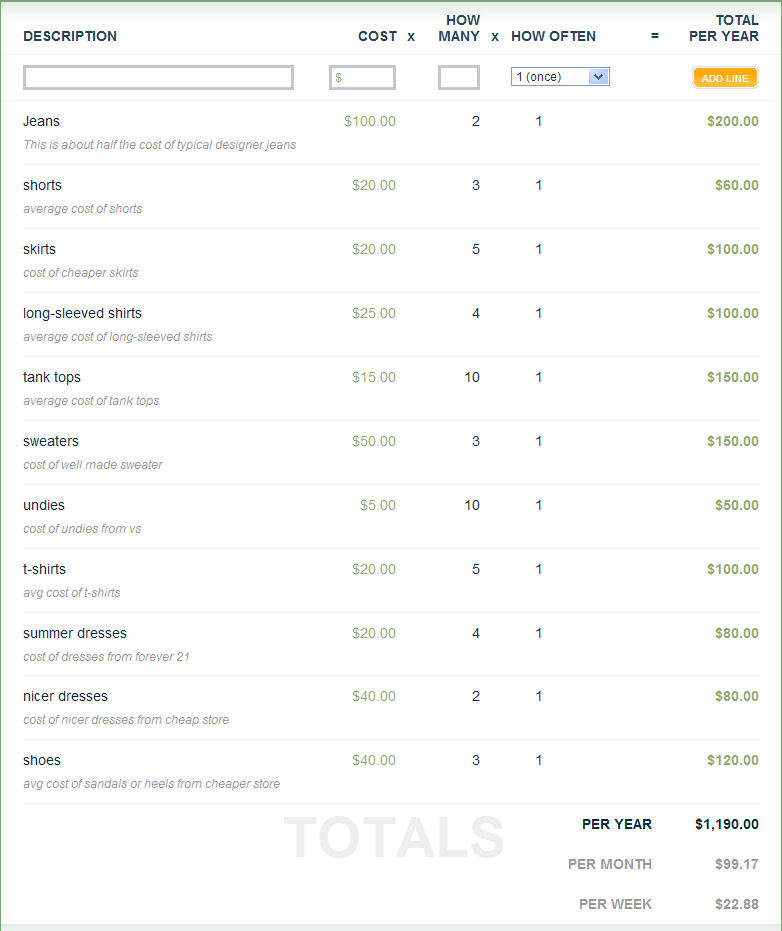
What's Your Teen's Clothing Budget and Allowance?

What’s your reaction to this clothing budget for an older teenage girl?

Older Teen Girl Clothing Budget Sample

Click to enlarge.

Here’s one of my favorite approaches to teaching kids how to spend wisely: put them in charge of a fixed budget for a specific area of spending. For teens, my wife and I always pick clothing first. It’s a well defined area. It’s a "need" that can quickly morph into a “want”. It’s something that most teens care about a great deal. It’s prone to lots of impulsive decision making and peer pressure. It’s often an emotional friction point between teens and their parents.

In other words, it’s a perfect opportunity for teaching your kids some fiscal discipline in a hands-on way.

Here’s our simple approach:

Have your teenager submit a formal annual clothing budget proposal

List each line item with estimates of typical price and quantity. This tends to be a real eye opener for the teen and even the parent!

Revise the budget proposal until it’s appropriate.

What’s appropriate? It depends upon your family’s financial situation, your family’s values, where you live, and numerous other factors. This phase invariably leads to meaningful parent-child dialog and greater common understanding. It’s a good idea to record some simple explanatory notes along with your final budget. The historical record can come in handy if (when) spending gets off track later.

Establish a regular allowance that matches the overall budget.

The allowance can be weekly, monthly, yearly, or whatever. We like to create an annual allowance and fund the clothing expense account all up front. This challenges our teenagers to handle a large chunk of money wisely over a long period of time. That’s a skill that takes some trial and error to master.

Track the balance and step aside.

Keep track of the running balance in the clothing account and, otherwise, leave the decision-making up to your teen. Well, for the most part. You’ll probably want to set a few basic ground rules up front about what’s off limits. Do what makes sense for your family. But, by all means, let them make the inevitable poor decision here and there. Let them experience the consequences. Make sure they clearly understand one hard and fast rule up front: when it’s gone, it’s gone.

Prom Can Take a Big Bite Out of That Clothing Budget!

Want to explore the topic more deeply? Here are two excellent resources:

How do you handle purchasing clothes with your teen?

How would you revise the sample budget at the top of this post?

on | LEAVE A COMMENT!

Getting Personal with 42 Billion Dollars (or lack thereof...)

Thought this was really cool. A buddy (thanks Chris) sent me a link to this little calculator published by the Sacramento Bee. It shows the estimated personal impact of the proposed California budget package. (Those are the default values in there on the right - pop in your own to see your personal story).

OK, the results of the calculation are not cool, but the idea of making the impact of obscure legislation available to the general public in real time in an interactive/personal fashion is a great use of the Internet.

Man, I knew we shouldn't have had all thosee kids - ouch!