Start a “Family 401(k)”. This is my all-time favorite family finance hack for teens with W-2 income from a summer or part-time job. It combines a Roth IRA with annual family matching. The arrangement encourages getting a job, forces a long-term investing mindset, and can be truly life changing decades later thanks to the magical power of compounding.
Use AI to decipher unexpected charges. As your kids learn the financial ropes with their first debit cards, the chances are near 100% that you’re going to stumble across charges you don’t recognize. When you do, try consulting an AI model from a trusted provider to track them down. The models are getting better and better at decoding cryptic charges and suggesting how to handle them.
Whether your kid is headed back to elementary school, middle school, high school, college, or even back to your guest room, here are 21 novel ideas for filling the financial education gap:
April is over. That means Financial Literacy Month is over too. Let’s hope the conversations linger though. Make thoughtful money conversations with your kids an ongoing activity.
Why? As Ben Franklin said:
An investment in knowledge pays the best interest.
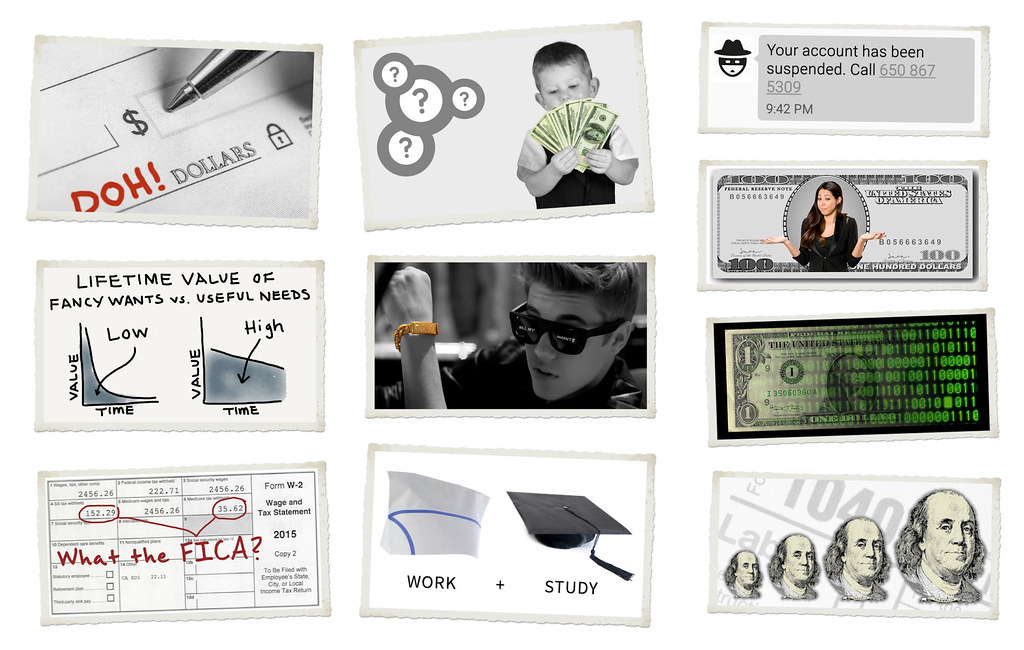
Looking for some fresh conversation starters? Here are the ten most popular topics from Family Finance Favs last month:
As part of our ongoing research at FamZoo, we’re constantly scouring the literature for fresh articles on family finance. We extract the best advice on how to raise kids who are responsible and thoughtful with money.
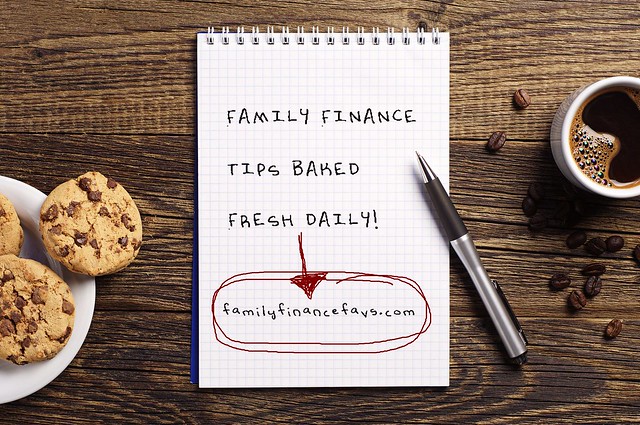
Now there’s a way to consume the very best tips we find, one manageable bite at a time. It’s called Family Finance Favs. (That’s short for “favorites” and has the long “a” sound like in “hey!”)
“Which business best addresses a consumer personal finance or investing problem?”
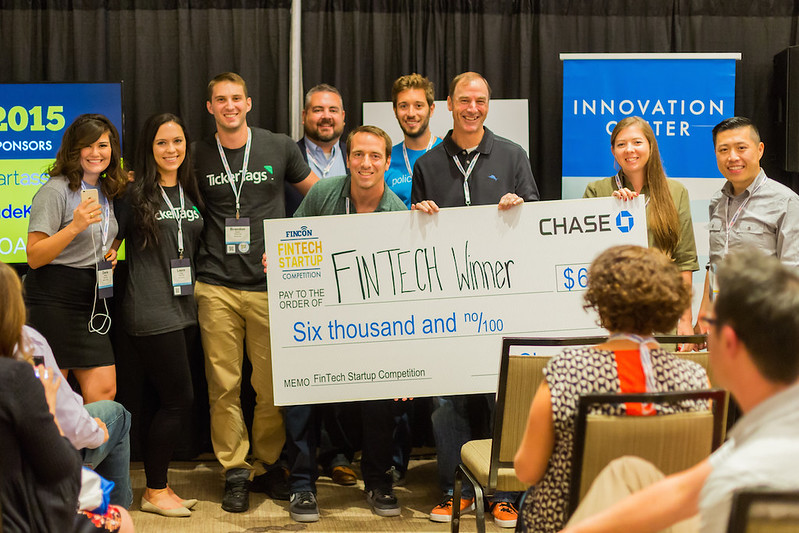
That was the question posed to 900+ FinCon15 attendees via a mobile polling app. The outcome would determine the winner of the People’s Choice Award at the annual FinTech Startup Competition.
The people spoke: FamZoo. Woot!
I can’t tell you how gratifying it is to earn the respect of the FinCon community for our efforts to improve the financial capability of kids and teens — and, surreptitiously, parents too! Here’s an audience who lives and breathes the personal finance challenges that everyday people face. Their opinion is a tremendous validation of the FamZoo mission and efforts to date.
But what about the formal competition judges? James Ray of Chase Merchant Services, Rachel Schneider of the Center for Financial Services Innovation, Dan Roselli of Packard Place, and J. Money of Budgets Are Sexy. What did they think?
They mulled over the following formal judging criteria:
Has the summary/presentation clearly articulated the value proposition?
Has the summary/presentation demonstrated market opportunity?
Has the summary/presentation demonstrated a sustainable business model that will make money, or, in the case of a venture with a social purpose, make money and have the desired social impact?
Has the summary/presentation demonstrated competitive differentiation/intellectual capital?
How effective was the overall presentation?
Would you invest or back this opportunity?
The judging panel spoke too: FamZoo. And TickerTags. A tie for first.
A tremendous honor, and a nice check to boot!
But what about you? What do you think?
Here’s an informal Periscope broadcast where I walk through an extended version of the demo.
The FinCon people have spoken. The judges have spoken. What say you?
P.S. Several folks have asked us how we plan to use the money. We always coach families to split income between important buckets like spending, saving, investing, and giving. That’s sound advice for families and companies alike, so we’re taking it ourselves. Here’s the game plan:
50% to spending: We have some immediate needs to address in our iPhone app, so we’re going to spend $3,000 on a dedicated iPhone development resource right away.
16.6% to saving: You never know when that next unanticipated expense is going to pounce! $1,000 is going in our “Emergency Fund” for the next thing to hit the fan.
16.6% to investing: Smart investing often entails having “dry powder” available to jump on an opportunity. We’re parking $1,000 to deploy on the next serendipitous growth partnership that comes our way.
16.6% to giving: FamZoo’s “secret ulterior motive” is to jumpstart the lifelong habit of philanthropy, and we like to walk the talk in this department too. We favor charitable missions that are tightly aligned with our own. That’s why we’re donating $1,000 to the fledgling Plutus Foundation to help bring financial capability to those who need it most.
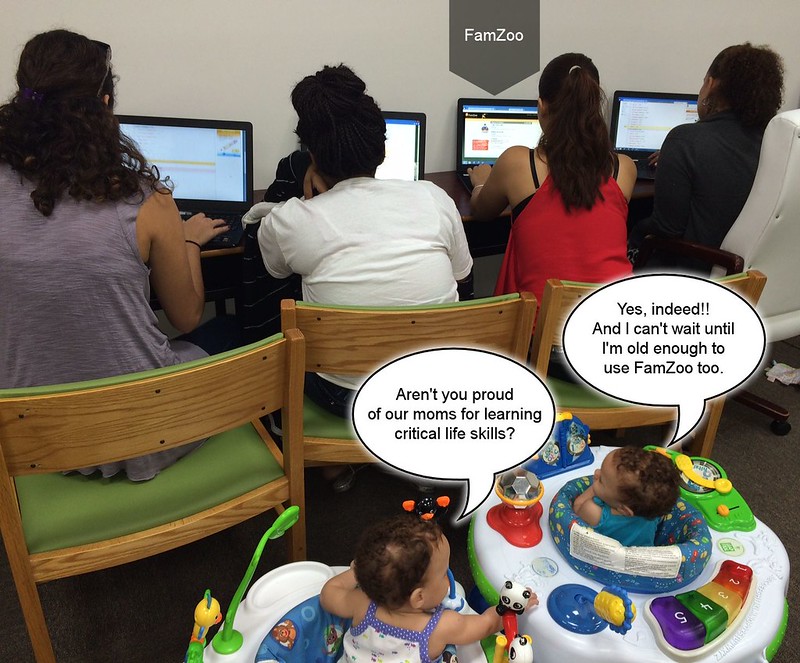
We’re always delighted to work with non-profit organizations who help families develop critical life skills. The Family Resource Centre on the Island of Grand Cayman is one of those wonderful organizations. Through its Young Parents Services program, clients bring their babies with them to the center four days each week where they participate in presentations, take educational online classes, learn about helpful parenting tools, and receive interactive parenting advice. The program promotes healthy lifestyles and habits to help equip the young parents with the skills they need to have a successful, well-rounded family and professional future.
Personal finance is clearly one of those valuable life skills, but how does FamZoo fit in when the kids involved are just babies? It’s not for the kids. It’s for the parents. Carlie Rowell, a program support worker, explains:
Financial literacy works best when it’s delivered in the moment on an as-needed basis.
I love that quote by Ron Lieber from his interview with J.D. Roth.
I’m convinced that good money habits stick as a result of numerous repeated nudges rather than a few epic lectures or various other “one-and-done” type educational efforts. If we can take it one step further and interject those little nudges into our kids’ everyday financial moments, I think we’ll really be on to something when it comes to having a lasting impact on behavior.
For many kids, math equals boooooring. It’s abstract and lifeless.
So, how can teachers make math come alive for kids in the classroom?
Michelle Reel, a 6th grade math teacher in Indianapolis, figured it out. She runs a “mini-economy” in her classroom. You see, money is always...well...interesting. No kid ever nodded off in class while buying stuff and counting money.
There’s one hitch though: the banking piece of the economy is a hassle. That’s why, back in May, Michelle wrote to us:
“Life should be better and richer and fuller for everyone, with opportunity for each according to ability or achievement.”
That’s a definition of the American Dream supplied by James Truslow Adams in 1931. The American Dream is the common thread running through this week’s family finance picks. Read on to delve into these deep family finance questions:
Are today’s 20 somethings engaged in the American Dream or the Me Dream?
How do we encourage the spirit of entrepreneurialism in our kids that is so central to the notion of the American Dream?
Is our society even equipping kids with the basic financial capabilities required to participate in the American Dream?
You’d be hard pressed to find parents who don’t want their children to enjoy the liberty of financial independence. So what’s the best way for parents to maximize the chances of that outcome? Perhaps the secret can be found in these wise money words from a great king of Sparta:
“By sowing frugality we reap liberty, a golden harvest.” —Agesilaus
Each of this week’s family finance picks contributes thoughtful insights on how we can start sowing frugal habits in our kids so they can reap the benefits in adulthood.