Showing posts with label Saving. Show all posts
on | LEAVE A COMMENT!

How To Raise Super-Saver Kids in 5 Simple Steps

Girl in superhero costume in front of savings chart.

George Samuel Clason’s 1926 classic, The Richest Man in Babylon, popularized the adage “pay yourself first” as a pillar of wealth building.

Easy to say. Hard to do. Particularly for kids.

How do we translate Clason’s undeniably sound principle into a lasting habit for our children?

Follow these five steps:

on | LEAVE A COMMENT!

Three Signs Kids Grok Compound Interest

Child looking at compound interest chart.

If you “grok” something, you really “get it.” It’s a term coined by the Sci Fi author, Robert Heinlein. It subsequently flourished in computer nerd circles — of which I have been a member since the early 80s. 🤓

How do you know if your kid groks the incredible power of compound interest?

Wait, let’s pause for a second...

on | LEAVE A COMMENT!

Automate Teen Payroll Deductions to Boost Summer Savings

Teen summer intern in bag factory.

It’s summertime, and one of my favorite customer service questions is back in vogue:

“Can my teen get paychecks directly deposited to their FamZoo card?”
on | LEAVE A COMMENT!

Beyond Cash and Gift Cards: 4 Creative Financial Gifts for Kids

Beyond Cash and Gift Cards: 4 Creative Financial Gifts for Kids

“Hey kid, here’s 20 bucks.”

“No thank you,” said no kid ever.

That’s right. No kid is going to hate you for handing over cold hard cash as a present this holiday season. The same holds for gift cards, as long as you get the brand right. That might be a little trickier than you think, judging by the billions of dollars worth of unused gift cards floating around out there.

And while cash and gift cards aren’t the most imaginative gifts, at least some folks get pretty darn creative on the packaging. Maybe you can even try your hand on some clever money origami this year.

Still, wouldn’t you feel a bit more thoughtful giving a financial gift that isn’t purely focused on immediate consumption? Perhaps something a bit longer term and, dare I say, educational?

I know what you’re thinking. Yawn. But bear with me, I’ve got some cool options that are worth your consideration.

on | 25 COMMENTS

Boost Your Kid's Money IQ with a Simple Spreadsheet

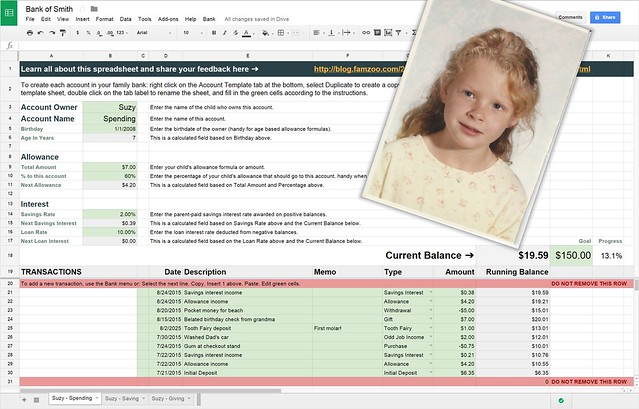
Sample Virtual Family Bank Spreadsheet

Let’s face it. Your kid’s piggy bank isn’t cutting it any more.

Sure, it was a fine first introduction to the most rudimentary concepts of money, but your kid is a smart cookie. Basic lessons learned.

So when are you going to take your kid’s money IQ to the next level? Your youngster is perfectly capable of grasping the following and more:

  • How bank accounts work.
  • How to track income and spending as numbers instead of coins.
  • How to avoid costly debt.
  • How to put money to work with compound interest.
  • How to allocate money to specific financial goals.

That sounds like a daunting parental task, but it doesn’t have to be.

You can do it all with a simple spreadsheet. That’s how I started out with my kids, and I’m not alone. The wildly popular financial blogger Mr. Money Mustache is doing the same. He’s using his “Bank of Mr. Money Mustache” spreadsheet to teach his young son about money too.

on | 9 COMMENTS

Why a Traditional Bank Savings Account Doesn't Teach Your Kid How to Save

Less than a penny in interest for a year of saving? Seriously?

What’s the best way to teach your youngster about saving and the power of compound interest?

Everybody knows you march your kid straight down to the local bank or credit union and open up a traditional savings account. Right? That’s certainly the conventional wisdom.

In fact, opening a savings account for your 6 year old is the “official” wisdom too. So says the panel of financial experts who make up the United States President’s Advisory Council on Financial Capability. It’s item 8 on their list of 20 things kids need to know to live financially smart lives.

My take? That’s complete bullcorn.

Let’s just think about this from a 6 year old’s perspective for a moment:

on | 2 COMMENTS

Everything You Wanted to Know about Kids and Saving, But You Were Afraid to Ask

Everything Your Wanted to Know about Kids and Saving, But You Were Afraid to Ask

Every parent knows kids should learn how to save, right?

OK, then, answer me this: how come only 1 percent of parents say their kids save any of their allowance?

Maybe parents have lots of questions about kids and saving, but they’re just afraid to ask.

That’s why we took to the Twittersphere with our friends @GiftOfCollege earlier this month. We posed 9 key questions about teaching kids to save, starting with the most basic: why?

Here are the 9 questions and an edited summary of the top answers.

on | LEAVE A COMMENT!

Is Your 6 Year Old Saving for College Yet?

Your 6 Year Old Can Start Saving for College Now!

How in the world can a 6 year old making in the neighborhood of $6 a week contribute meaningfully to a college savings fund? Easy. A “micro-savings” card, a split, and a Gift Of College account will do the trick.

on | LEAVE A COMMENT!

5 Family Savings Resolutions for the New Year

Family New Years Resolutions

Prepaid card accounts and bank sub accounts are perfect for automatically building up little “buckets” of savings. Family members young and old can set up automatic deposits, allowance splits, or transfers that drip funds into special purpose accounts week after week. Just set it and forget it. After a while, you’ll have much more than a drop in the bucket.

Here are 5 savings buckets to consider setting up in your family as you kick off the new year:

on | 5 COMMENTS

4 Big Things Your Teen Can Save For

Your teen CAN save for a car. Try the 401DAVE plan.

When it comes to big expenses, most of us parents are giving our teens too much credit and too little credit, all at the same time. How so? On the one hand, we’re giving our teens too much credit (in the form of dollars) by covering big ticket items for them — often when we can’t even afford them ourselves. On the other hand, we’re giving our teens too little credit (in terms of respect for their capabilities) by assuming they can’t handle paying for at least a portion of these major expenses on their own.

This dawned on me last week while reading Smart Money, Smart Kids. (Why am I reading the new book by Dave Ramsey and his daughter Rachel Cruze? See the first post in this series here.)

Here are 4 big expenses that your teen is perfectly capable of paying for, despite your assumptions otherwise:

on | LEAVE A COMMENT!

8 Unique Family Finance Tips for Saving Money

What is your number one little known, yet important tip for how families can start saving money today?

That was the question posed to family finance experts recently and featured in the article 32 Family Finance Experts Reveal Their Top Tips for How Families Can Save Big Money.

32 Family Finance Experts Reveal Their Top Tips for How Families Can Save Big Money

Of the 32 entries, here are the 8 that I felt were most unique and why (excluding a virtual family bank of course). Click through on each one to see the expert’s explanation:

on | LEAVE A COMMENT!

Positively Parenting and Personal Finance for Kids

Positively Parenting Interview: Teaching Kids Good Money Habits

Roxanne Lochridge is a “Mama” to 3 youngins, a positive parenting evangelist, and a “family scientist.” In a recent interview, Roxanne grilled me on the following topics:

Want to know the answers? You can listen to the interview here or click on the links above to jump right to the answer in the transcript below.

on | LEAVE A COMMENT!

10 Good Money Habits to Teach Your Kids in 2014

Resolve to Teach Your Kids Good Money Habits in 2014
2013 is coming to a close, and it’s time to make those dreaded New Year’s resolutions again. Pffft! Are you tired of making and breaking the same old promises each year? You know: lose weight, exercise more, quit your favorite vice, blah, blah, blah. Not.

How about switching it up with something new this year? Something that can really change the lives of the people you care most about. Something concrete and doable. Here’s my simple suggestion: resolve to teach your kids good money habits.

Don’t know where to start? Intimidated? Here’s a list of 10 simple habits that will put your kids on the path to financial responsibility:

on | LEAVE A COMMENT!

Jumpstart Your Virtual Family Bank with a TripleGift

Money probably ranks right near the top when it comes to gifts that are well received by kids. No brainer, right? So, what does a kid love better than a wad of money stuffed in a birthday or holiday card you ask? Three wads of money stuffed in a card, of course! That’s what a TripleGift is.

But, wait. It it’s not as crass as it sounds. In fact, it isn’t crass at all. A TripleGift is the thoughtful way to give a monetary gift. That’s because the other two wads of money aren’t for spending. They’re for saving and charitable giving. Each TripleGift greeting card comes with three labeled pouches for spend, save, and share funds. It’s a great way to send a thoughtful, balanced money message to a child on a special occasion: money is about much more than just spending.

So what could be even better than a TripleGift card? A TripleGift card plus FamZoo, of course. Turn that positive TripleGift money message into an ongoing personal finance education. Tuck a FamZoo gift subscription inside your TripleGift card so the recipient can immediately deposit their new funds into spend, save, and share virtual family bank accounts.

Deposit Your Child's TripleGift Amounts into FamZoo's Virtual Family Bank Accounts

Better yet, if you can plan it with the child’s parents, give them the FamZoo gift subscription in advance so they can register their virtual family bank, order spend/save/share FamZoo cards, preload some initial funds onto each, and stuff the FamZoo cards into the TripleGift pouches for the recipient ahead of time.

Put FamZoo Prepaid Cards into TripleGift Spend/Save/Share Pockets

Interested? To learn more, check out my guest post over on the TripleGift blog.

You can order a TripleGift card here and a FamZoo gift subscription here.

on | LEAVE A COMMENT!

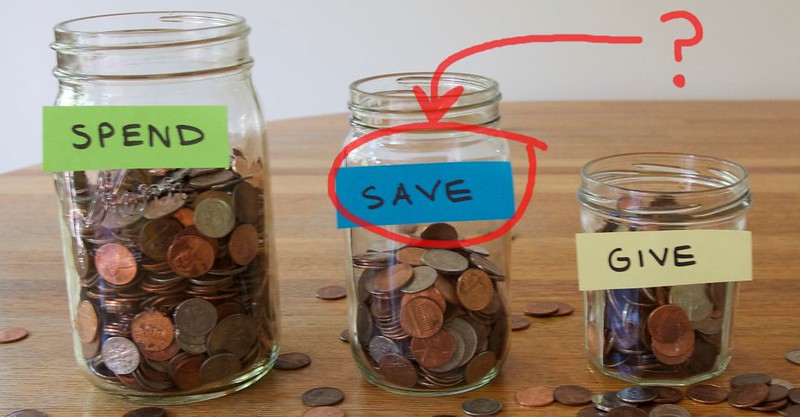
What's the best allocation between spending, saving, and giving for kids?

“Do not save what is left after spending, but spend what is left after saving.”
~Warren Buffett

FamZoo Average Spend/Save/Give AllocationsSmart advice from an undeniably smart investor. The saving (and charitable giving!) should come before any thoughts of spending. How do you make that happen? Automate it. Arrange to have some money automatically set aside from your regular paycheck. Out of sight, out of mind. It’s a strategy that has worked incredibly well for me personally, and something I recommend to all.

Why not start the habit early with kids? If we do, maybe it’ll be second nature by the time they enter the workforce.

“But my kids don’t get paychecks,” you say. Hmmm. What about the money you pay them for allowance, or chores, or odd jobs? What about the money they earn from watching the cat next door or babysitting? What about those birthday checks from grandma and grandpa? Those are informal “paychecks.” Apply Warren’s principle.

on | 2 COMMENTS

Give Your Child Financial Perspective with Savings Goals: Family Finance Picks #73

One of the easiest and most effective ways to give your child some much needed financial perspective is to have them make a savings goal. That common theme runs through each of this week’s family finance picks:

Millennium Falcon Lego Set Savings Goal

on | LEAVE A COMMENT!

The Three Best Ways to Teach Kids about Money: Practice, Practice, Practice. Family Finance Picks #64

Practice, practice, practice. Everyone agrees that kids need lots of practice to master a skill, right? Whether its sports, academics, music, you name it.

Games Entertain. Experience Teaches.So why not give your kids lots of practice when it comes to the critical life skill of managing their own money? Without it, your kids are headed for trouble. Kids can’t fully develop personal finance skills by playing games or by having you make all their financial decisions for them. That’s like expecting your child to become a great hockey player by playing an online hockey video game or just watching you skate around the rink.

So, where do you start?

To practice, kids need some real money of their own. Don’t get too bogged down in classic allowance vs. paid chores debates when it comes to determining your child’s source of income. Just pick an income source and amount that makes sense for your family’s situation. Then, give your child the freedom and responsibility to make regular spending, saving, and giving decisions with that money — within some minimal set of basic boundaries that you establish.

Through repetitive trial and error along with your guidance, your kids will develop the skill of making wise money decisions.

Practice makes perfect — or, at least proficient.

With the “real world practice” theme in mind, here are the family finance picks of the week:

Why Monopoly Is A Terrible Finance Teacher

A bit of a “party pooper” post from Investopedia about Monopoly, but a good reminder that the best games are designed first and foremost to entertain. To really learn something, like personal finance, nothing rivals real experience. It’s all about (real) practice.

Discuss on FaceBook.

Websites Encourage Kids to Learn about Finance Online

FamZoo Mom, Suzanne Skyvara, was back on public radio again last Friday in this longer four and a half minute interview segment — an expansion of the original shorter broadcast here. Suzanne describes how FamZoo helps her kids practice making financial decisions like the trade-off between spending extra money on a soda now versus saving it toward a video game purchase later. The experiential learning includes living with the consequences of truly bad decisions, too: like losing $10 to your brother over a spontaneous bet about the name of a video game. Oops.

Related FamZoo Activity: Review your child’s financial decisions with them each month.
Discuss on FaceBook.

How Much You Should Pay Your Kids For Allowance

Ryan pens a solid, and pretty typical, article on allowance basics. He wades into some of the classic debates such as whether or not to pay for typical household chores. The gold of the article is all in the “Bottom Line” section at the end. Ryan reinforces the notion that the true value of an allowance is creating an environment in which kids can practice making financial decisions. That’s nicely captured in the classic allowance-amount axiom that Ryan highlights:

A child’s allowance should be enough to allow them to buy something small right now or save for something big later on.

Related FamZoo Activity: Help your child track progress on a savings goal.
Discuss on FaceBook.

We’re constantly scouring the Internet looking for articles related to family finances and teaching kids good personal finance habits. You can visit our ever growing list of family finance bookmarks here. We’re up to 2,992 now!

on | LEAVE A COMMENT!

How to Encourage Your Kids to Save and Give with Matching Contributions

Automatic MatchingIn the adult world, it’s common for an employer to match a percentage of an employee’s contributions to a retirement account or a non-profit organization. Employers know that a matching policy is a powerful stimulus for driving good saving and charitable giving habits by employees.

Parents will find that the same technique works well with kids. That’s why we’ve made matching super simple for parents to administer in FamZoo by adding an automatic matching capability to our virtual family bank accounts.

Here’s how it works for a typical scenario: Suppose you’d like to encourage your daughter’s charitable giving by kicking in a 50% matching contribution for every deposit she makes to her charitable account.

Edit the Account Settings

To set up the 50% matching, locate your daughter’s charitable account on the Accounts page of the Bank tab, hover over the account with your mouse, and click on the pencil icon to edit its settings. (If you don’t already have a charitable account set up for your daughter, you can click on the Create Account action link to create one.)

Edit the Account Settings

Fill in the Matching Credit Details

Check the box to turn on automatic delivery of matching credits. Fill in a matching percentage — 50 in this case — and a description to be included as part of each matching credit transaction. We’ll use “Charitable match from Dad.”

Fill In The Matching Credit Details

The Next Time a Deposit Hits the Account...

Now any deposit into your daughter’s charitable giving account — whether it’s an automatic one from an allowance or chore, or a manual one from an odd job or gift — will be followed by a matching deposit of the specified percentage. To generate a sample matching transaction, let’s say your daughter gets paid $20 for some babysitting next door and you choose to split that between her accounts using the Split Credit form with 10% of the $20 (or $2) going to her charitable giving account.

The Next Time a Deposit Hits the Account...

A Matching Credit Will Automatically Appear

After completing the split credit, you can visit the Transactions page to confirm that the appropriate matching credit transaction has been automatically added to your daughter’s charitable account. The matching transaction description includes the match description we supplied earlier (“Charitable match from Dad”), the matching percentage (50%), and the amount being matched ($2). The Memo field identifies the original deposit that caused the match, which should appear immediately below.

A Matching Credit Will Automatically Appear

A subtle note about deleting matching transactions: if you delete the original transaction, the matching transaction will automatically be deleted as well. The converse is not true. If you delete the matching transaction, the original transaction will remain untouched. That makes it easy to selectively undo an individual matching contribution if desired.

Happy matching!

As always, if you have any questions or feedback, don’t hesitate to contact us.

on | LEAVE A COMMENT!

Two New Featurelets: Capping Interest and Displaying Account Descriptions

Cap Interest PaymentsWe rolled out two handy little features (aka “featurelets”) this week as part of our upgrade:

  • the ability to enforce a maximum amount on interest payments, and
  • the display of account descriptions on the Transactions page.

I put together two short Quick Tip videos to show you how you can use each of the new featurelets.

Putting a Cap on Interest

If you’re giving your kid a super awesome compound interest rate on a virtual savings account, you’ll want to check out this new feature.

It’s a cap or maximum on interest payments, so the amounts you’re paying out don’t get too out of hand as your youngster saves more and more over time.

Check out the Quick Tip video to see how it works:

Displaying Account Descriptions

Have you ever wished the description you entered when creating an account could be displayed somewhere in FamZoo where your child could see it?

Maybe you’re using the account for some special or unusual purpose and you want to make that clear.

Now you can with a new feature that displays the account description — if there is one — at the top of the Transactions page.

Check out the Quick Tip video to see how it works:

Questions? Comments? Contact Us

We hope you have fun with the new featurelets.

And, as always, if you have any questions or comments, please don’t hesitate to contact us.

We always love hearing from you.

on | 1 COMMENT

Young America Saves: Start the Habit Early with FamZoo

Encourage Your Kids to Save: America Saves Week starts Feb 19, 2012America Saves Week starts Sunday! Are you looking for a way to kickstart your youngster’s savings habit?

“Let’s open a savings account for the kiddo!” you say. Not so fast.

To quote David Owen, author of The First National Bank of Dad:

To a kid, a savings account is just a black hole that swallows birthday checks.

He explains further:

Most efforts by most parents to teach most kids about money are doomed from the start. Those efforts usually begin (and often end) with the opening of savings accounts. The parents suddenly decide that the time has come to impose order on their children’s chaotic financial affairs, so they march the kids down to the bank and sign them up for passbooks. The children are intrigued at first by the notion that a bank will pay them for doing nothing, but their enthusiasm fades when they realize that the interest rate is minuscule and, furthermore, that their parents don’t intend to give them access to their principal.

Fortunately, there’s a new alternative — one that holds your child’s enthusiasm, instills good savings habits, and involves no marching anywhere. It’s a virtual savings account at your very own online Bank of Mom/Dad. It’s a bank where you, the parent, are the bank manager. You make the rules. That means you can set the interest rate and the compounding frequency to something that is compelling to your kid — not minuscule and yawn-inducing.

It’s a bank where your kids have their own access. They can:

  • sign into their own accounts,
  • set their own savings goals,
  • make their own savings plans,
  • monitor their own progress.

No more black hole that swallows birthday checks!

Here’s how you can get going right now (click images to enlarge screen shots):

1. Register

1(b) Add your child1(a) Register your familyRegister your family. If you’re signing up on FamZoo.com, you can try it free for 2 months. We don’t require any payment info up front — just the email address of the registering parent.

2. Create an account

2 Create an accountFollow the guided instructions in our pop-up bubbles to create one or more virtual accounts. Decide what kinds of special incentives you’d like to give your little saver. Perhaps an aggressive interest rate or a matching contribution at certain intervals.

3. Create a savings goal

3 Create a savings goalYour child can sign into your new online Bank of Mom/Dad and create a savings goal.

4. Plan a savings strategy

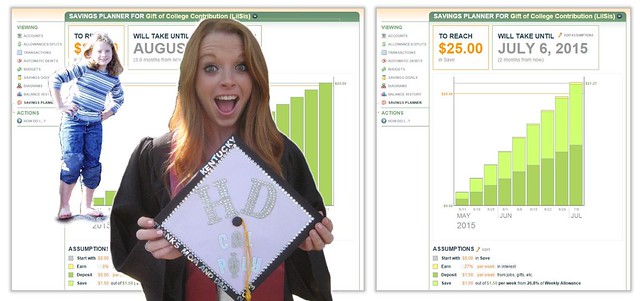
4 Plan a savings strategyYour child can use the savings planner to work through different scenarios and predict when the goal will be achieved given different savings assumptions.

5. Monitor progress

5(b) Record the purchase5(a) monitor progressYour child can monitor progress toward her goal on her own account dashboard.

Once your child has saved enough to achieve the goal, you can either hand over the funds or make the purchase on her behalf. Then debit the appropriate account to record the purchase.

That’s all there is to it! Get started now!